Decoding Dholera Smart City: Are You Buying the Smart City—or Just the Story?
- Prop Sach
- Jul 14
- 4 min read

Every major real estate boom begins with a compelling story. Dholera Smart City Investment is one of the most talked-about opportunities in India's real estate market.
A new airport. A world-class industrial hub. Massive government investment. Infrastructure worth thousands of crores. Early investors becoming millionaires.
Dholera SIR has all the ingredients of that story.
The project is real. It is backed by the Government of Gujarat, forms part of the Delhi-Mumbai Industrial Corridor (DMIC), and is one of India's largest planned greenfield smart cities.
But here's the question very few investors ask before signing the cheque:
Are you actually buying land in Dholera SIR, or are you buying land that is merely being marketed under the Dholera name?
That single question could determine whether your investment participates in the city's growth—or simply waits for another buyer to believe the same story.
Not Every Dholera Smart City Plot Is Part of Dholera SIR
Most first-time investors assume that any land advertised as "Dholera Smart City Plot" is part of the government's planned development.
It isn't.
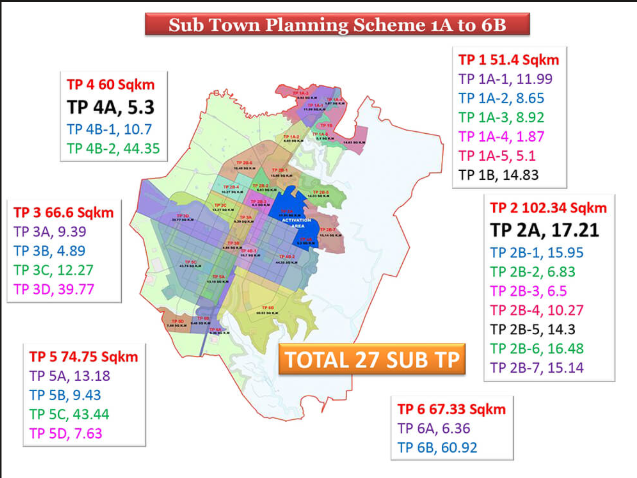
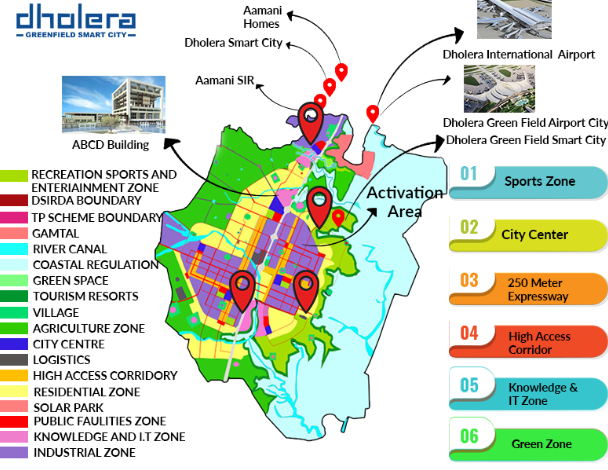
Dholera SIR covers a defined, notified area divided into multiple Town Planning (TP) Schemes, with infrastructure currently concentrated around the Activation Area. This is where roads, utilities, administrative buildings and industrial infrastructure are actually taking shape.
Yet a significant portion of the land sold by brokers lies outside this core development zone—and, in many cases, outside the notified SIR itself.
The advertisement says "Dholera."
The map often tells a different story.

What will you get if you buy a land outside Dholera SIR project?
Zero Infrastructure: Inside plots get smart grids and automated utilities. Your plot gets nothing—no municipal water, no power lines, and zero civic maintenance.
Legal Paralysis: Your land stays locked as Agricultural. Getting Non-Agricultural (NA) clearance independently is a bureaucratic nightmare. Build without it, and government bulldozers can legally flatten it.
The Landlocked Trap: The roads on the broker's brochure do not exist on official maps. Once they disappear, local farmers can block access, leaving you with a plot you cannot legally step foot on.
Unsellable Asset: No investor or corporation will buy your plot because it lacks infrastructure and building height rights (FSI). Your life savings are permanently stuck in an illiquid piece of dirt.
Bank Rejection: Banks check coordinates via GIS mapping. The moment they see your survey number falls outside the official Town Planning scheme, your loan application is instantly blacklisted.
The Land You're Shown May Not Be the Land You're Imagining
Here's how the sales pitch usually works.
You are shown videos of six-lane roads, drone footage of the Activation Area, government buildings, and industrial projects. The future appears inevitable.
Then you're offered a much cheaper plot several kilometers away because "land inside Dholera is difficult to get" or "retail investors cannot buy there."
By the end of the conversation, you've mentally connected your plot with the infrastructure you've just seen—even if the two are nowhere near each other.
The project sold your confidence.
The location sold to you may not.
The Broker Gets Paid Today. You Wait for Decades.
Most brokers earn their commission the moment the sale is completed.
Your investment journey begins only after that.
Dholera is a long-term infrastructure project that will likely take decades to mature fully. While development around the Activation Area is visible, many surrounding regions have yet to witness meaningful residential or commercial activity.
Ask yourself a simple question:
If the city takes another 20 years to mature, are you comfortable locking your money away for that long?
Because that is a possibility every investor should consider before expecting quick appreciation.
Buying Is Easy. Selling Is the Real Test.
Almost every brochure explains how easy it is to buy land.
Very few explain how difficult it can be to sell.
Unlike established real estate markets, demand in many parts of Dholera is still driven largely by investors rather than end-users. That means your future buyer may not be someone looking to build a home or start a business—it may simply be another investor hoping prices will continue to rise.
If that chain of buyers slows down, liquidity becomes the biggest risk.
There is a saying frequently heard among investors familiar with the region:
Buying land in Dholera is easy. Selling it is where the real challenge begins.
One Wrong Location Can Change Everything
Two plots may both be advertised as "Dholera."
One sits inside an active TP Scheme near the Activation Area.
The other is agricultural land in a nearby village outside the notified SIR boundary.
They may be separated by only a few kilometers.
Their long-term prospects, however, could be vastly different.
The problem is that many investors never verify which one they are actually purchasing.
Before You Invest, Ask These Questions
Before paying a booking amount, ask your broker to answer these questions in writing:
Is the plot inside the officially notified Dholera SIR boundary?
Which TP Scheme does it fall under?
How far is it from the Activation Area?
Is the land agricultural, residential or industrial?
Can the exact survey number be shown on the official TP map?
If you decide to sell within five years, who is the likely buyer?
If these questions cannot be answered clearly, that uncertainty is itself a risk.
The Final Verdict
Dholera SIR may well become one of India's most significant infrastructure projects over the coming decades. But the success of the project does not automatically make every nearby land parcel a sound investment.
The biggest mistake investors make is assuming that anything sold under the Dholera name will benefit equally from the Smart City's growth.
In real estate, the difference between a profitable investment and a costly mistake is often measured not in kilometers—but in boundaries, planning maps and patience.
Before you invest in Dholera, don't just ask whether the city has a future.